Friday, 17 September 2021
Healing Power of Broccoli

Monday, 28 December 2020
The Healing power of Celery

Thursday, 24 December 2020
 |
| Angela surrounded by Devon moss |
This year I had plans to escape the English winter, well-laid, careful, detailed plans, which included flying to Tenerife, catching a boat to the beautiful, green Canary island, La Palma, travelling by bus across the steep hilly island and meeting my friend, Frohmut, who would take me to one of her caves, where I would dwell as a troglodyte, far from the British permagrey skies, tilling her stony soil, weeding her veg patch and pruning her tangerine trees, spending the evenings by a nice fire in her cave, catching up on all the years since we last spent time in this place.
But it was not to be. Spain's decision to ban all Brits scuppered my plans.
So instead I am admiring the beautiful green moss in Devon.
Healing plants this time of the year are few and far between, but I will go and look for some tomorrow.
Monday, 2 April 2018
Journey from Delhi to Goa
"I'm not sharing a compartment with them!"
The minders took them away.
Strange, I thought, taking prisoners on the Rajdhani, in an air conditioned carriage!
Later one of the minders came back to my compartment, lay down on the top bunk opposite mine and went to sleep. When he woke up and climbed down he looked at me and began to speak, with difficulty, in English. He was a nice looking, slim young man with a pleasant face, dressed casually in jeans and shirt and he said:
"Those prisoners you saw not in this carriage. In next carriage."
"Are they sharing a compartment with other passengers?" I asked.
"Yes. All three on a top bunk together. Other passengers sitting below and talking to them. One is murderer. Two are diamond thieves. I police officer, taking them to Surat."
"I've never been to Surat. What is at Surat?"
"Rough diamonds. Diamonds cut in Mumbai. Rough diamonds in Surat."
"Where do they come from?"
"Africa."
"So there's a lot of crime in Surat."
"Yes a lot of crime. Big gang stole many diamonds. We catch nine. Police tracking other men in Lucknow, tracking phones. Very dangerous men."
"You live in Surat with your family?"
"No family live in Buj. Buj nice place. I see family once every two weeks. I must stay in Surat six months."
He looked at me wistfully.
"Very lonely Surat. And much tension."
Journey from Murshidabad to Kolkata
Somehow I managed to squeeze in but not to sit. Luckily at every station people get off and people get on, so I soon found a space on a very hard seat beside a woman who was shaking a baby to try to stop it from crying, unsuccessfully. Vendors of every food imaginable somehow managed to squeeze through the crowded compartment, plus sellers of household goods: clothes pegs, toys, tablecloths, rucksacks, drinks, sticky looking chana (chickpeas) that looked like it was going to be spilled over me but somehow managed not to, blind musicians, assorted beggars, loud clapping Hijras, dressed in brilliant red saris, who go up to the men and demand money aggressively; all of whom get out of the compartment at the next station and a fresh lot of vendors, beggars, musicians etc get in and struggle through.
I could hardly hear him crying above the calls of the vendors, beggars, musicians, but noticed that the baby's mother and grandmother were taking it in turns to shake the baby, who continued to cry pitifully, his sweat-streaked hair clinging to his forehead as he writhed in their arms. At the next station they took the wailing infant off the train. On the other side of me were a young couple who'd been married a year, didn't speak a word of English but smiled sweetly and indicated that they wanted to look at my photos. So we looked at photos on my mobile phone. He indicated that his mobile was out of battery. I found a lead and plugged it into my power bank.
At the next station a vendor of dubious looking herbal remedies got on and stood like an orator giving a speech about his wonderful products. A man spent a few rupees on one of his remedies. After about three hours the train stopped, people left their handkerchiefs to mark their seats and got off to buy the better station food, as opposed to the food they'd been eating from the vendors on the train. Presumably there was a toilet somewhere and this was an opportunity to use it since there were no toilets on the train. But I had no idea where to look and anyway was afraid of not finding my way back to my seat and my luggage, so didn't dare venture far. I decided not to drink so that I would last the six hour journey.
When the train started again a very feisty Hijra came into our compartment, clapping loudly as usual, going up to the young men, pushing them roughly, probably taunting them (of course I couldn't understand her Bengali) and demanding money. She came right up to me and looked me in the eyes, tossed her head and held out her hand. My neighbour indicated that I'd better give her some money, so I handed over another ten rupee note. I'd been handing out ten rupee notes, of which I had a huge pile, throughout the journey. A curd (yogurt) seller got on at the next station, with two buckets filled with miniature clay pots of curd. A pan seller arrived, with a marvellous array of different coloured powders, then a man selling pins, toothpicks and combs, who hung his wares from the roof, rattled off his spiel, then unhitched his wares, moved on and hung them up again.
Eventually the vendors began to thin out, a general somnolence began to take over, as all who were fortunate enough to have a seat began dozing off, on each other's shoulders. By now enough people were sitting for me to see out of the window, where the growing rice was clothing the countryside in brilliant green, between fruit trees, banana plantations, saal forests and villages with little houses.
A group of young women went through the carriage singing a Bollywood song at the tops of their voices. A fake gold chain seller held forth loudly, competing with the singers in his attempts to persuade someone to buy one of his chains.
Just as we were leaving DumDum station, someone said that there was a metro station there. Too late for me to get out of the train, I continued on to Sealdah, where a kind man said to me,
"Get off here, cross over to that train there. It's going back to DumDum. Stand by the door and make sure you get off there!"
And so I was able to get the metro all the way into central Kolkata from DumDum station.
Tuesday, 27 March 2018
Itkhori

According to Sir Edwin Arnold, in 'The Light of Asia,' Buddha came to Itkhori before his long walk to Bodhgaya where he was enlightened, and according to local legend, it was here at Itkhori that his aunt Prajapati Gautami lost him and screamed "iti koi" (iti = here koi = lost). Hence the derivation of the name Itkhori.
During the Gupta Period a ruler built a large Buddhist temple here. Later the temple became a Hindu temple and at some point it may even have become a Jain temple. But unlike many such temples in Cambodia, Laos and Thailand, which have remained as testimony to their changing religious affiliations, with a mixture of Buddhist and Hindu iconography, this temple was destroyed. Few people knew about it until sometime in the twentieth century, when farmers began to unearth stone sculptures with their ploughs and this came to the attention of Bulu Imam and his sons, who persuaded the villagers to keep the sculptures in a safe place.

Gradually over time a large quantity of stone sculptures and pieces of the architecture of the temple came to light and were stored in an old school. Eventually money was found for a makeshift 'museum' for them. The museum is kept locked but we were taken there by a caretaker who unlocked the doors, switched on the lights and ushered us in to a dusty room where Hindu, Jain and Buddhist sculptures and pieces of the old temple were stacked on top of each other in untidy rows with an occasional label in Hindi.
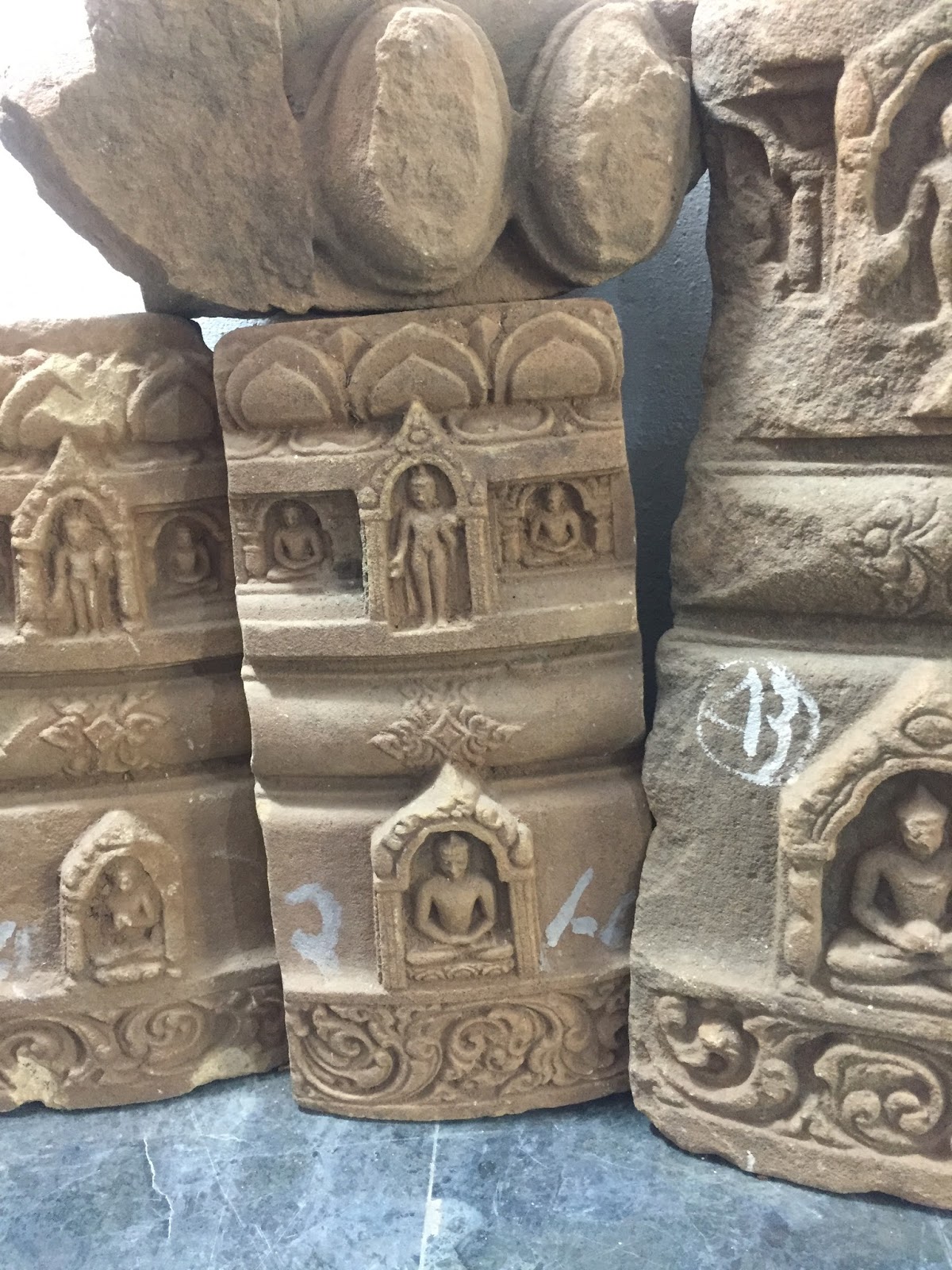
An application was made for Unesco status and funding was allocated, then suddenly the whole site was covered with concrete, obliterating the rest of the remnants of the ancient temple and a huge Hindu temple was built on the site. Had the site been carefully preserved it is possible that sufficient pieces of the old temple could have been unearthed to re-construct it, more or less as it originally was, as they did in Bodhgaya. But now it is too late. Sad remnants of the ancient temple still line the outer perimeters of the new temples. And Hindu worshippers worship a Buddhist Tara statue, mistaking her for Kali, in one of the Hindu temples.

The chief Minister has announced that he will build an enormous new Buddhist temple at Itkhori, which will go some way towards recognising it as a Buddhist site, but the temple will not include any of the old stone architecture. Large colour pictures of the projected Buddhist temple are displayed high up on the walls of the 'museum' at Itkhori. The Unesco application still awaits.
There are several villages around Itkhori where Buddhist sculptures have come to light. We visited Daihar village, a village of fifty two lanes and fifty two wells. Old Buddhist, Jain and Hindu statues have been pulled out of some of the wells, the better preserved pieces taken to Ranchi, the broken pieces piled in heaps in the lanes, where the villagers revere them with marks of vermillion, wrapping the odd piece in red cloth, as a mark of respect. As I stared down into the depths of one of the wells, too deep to see the water at the bottom, I marvelled at how, hundreds of years ago, these villagers could have dug and built the walls of such deep wells.
Over the years many ruins of the Buddhist monuments and statues have come to light in different parts of the state of Jharkhand. According to T. Bloch, several Buddhist remains were found five and seven kilometres from Dalmi and Budhpur in Dhanbad district, dating to the tenth century AD, according to Beglar. In 1918 FM Holo found Buddhist sculptures at Suraj Kund village in the Hazaribagh district near some hot springs. At Belwadag village, three km east of Khunti in Ranchi, an excavation has revealed a Buddhist Vihar, constructed of bricks similar to those used to build the Buddhist stupa at Sanchi. Buddhist statues have been discovered in places like Jonha of Ranchi district, Katunga village of Gumla district, Bhula village of Jamshedpur (East Singhbhum) and Ichagarh in Dhanbad district.
At Mangarh a brick work Buddhist Stupa, twenty feet by twenty feet has recently come to light. At Tultul, near a waterfall, Koleshwari temple is Buddhist, Jain and Hindu. Some of these statues and parts of monuments have been taken to the post-graduate department of history of Ranchi University, but they are not well cared for. In the current climate of Hindutva, little importance is given to Buddhist archeological remains in India.
The UNESCO application for recognition of Itkhori as an important Buddhist site still awaits a response. Hopefully if it is recognised, attention can be drawn to the importance of Jharkhand as a major Buddhist destination. If money is provided for excavation and a proper museum, many more Buddhist sites will probably come to light.
Saturday, 24 March 2018
the World of Rock Art Exhibition


Friday, 16 March 2018
Sunderbans

We travelled to the Sundarbans with backpackers, 4 Tottie Lane, Sudder Street, Kolkata.
Our departure was delayed by the New Zealand bloke forgetting to bring his passport, which entailed a long diversion to his hotel to collect it. As we drove through the city we passed numerous people washing clothes, dishes, themselves by the side of the road where the city taps are opened twice a day for the use of the homeless and all those who do not have running water. Men strip off down to their underpants and scrub themselves enthusiastically right beside the road, as the heavy traffic thunders by. I never did discover how the homeless women manage to wash adequately. We were driving through a part of Calcutta with tree lined streets, the trees leaning over the road to touch in the middle, creating a dappled green canopy. We entered a market, selling garish bright coloured clothes and ground to a halt amidst hordes of people, queues of buses hooting deafeningly, out of frustration, since no amount of hooting made any difference to the traffic jam. It took an hour and a half to get out of Kolkata, into a lush, green area of smelly canals, banana trees, maize, vegetables, trees, coconut palms, villages, lakes and a gigantic rubbish dump. Then we passed a series of fish farm lakes on one side and a whole area given over to brick kilns, belching out evil looking smoke on the other.
After three hours we reached our boat, the Mangrove Matal. We stopped at the first island to buy beer at the request of the New Zealand bloke, who, it seems cannot function without the stuff, but the beer shop was shut, so we continued past rows of pleasure boats anchored and waiting for tourists, but the main tourist season was over. All manner of small cargo ships ply this waterway between Kolkata and Bangladesh.
Originally all the branches of the Ganga and the Bramaputra between them emptied their sweet water into the Bay of Bengal giving rise to hundreds of mangrove islands which thrived on the sweet/salt mixture of water. The area was called by the locals Sundar, meaning beautiful and bans, meaning forest: hence Sundarbans. In the sixteenth century the British East India Company, wanting to create a trading base in this watery swamp, constructed Fort William on one of the islands, then, afraid of being attacked by the Marathis, they began building walls and dikes round the island, eventually blocking off all the outlets of the Ganga except the Hoogli, thus depriving a large part of the Sunderbans of its sweet water source. Fort William was later to become the centre of the new town called Calcutta. The tide continued to flow in and out of the area, so the environment changed to a salt water one, the trees adapted by reducing their size and the animals adapted to drinking salt water when they couldn't find any fresh water. The animals managed to survive long enough to breed but they lived, and live, short lives, eventually suffering multiple organ failure, all except the aquatic ones, such as the crocodiles, which thrived.
Churchill, who hated all Indians with a passion, drew a line through Bengal, determining where the state would be partitioned, thus separating the jute growing area from the jute processing area and so ruining the jute industry at a stroke. Churchill's line cut right through the Sundarbans, granting two thirds of the mangrove islands to East Pakistan (now Bangladesh) and one third, the salt water third, to India. There are 102 islands on the Indian side, some of which are inhabited, many of which, on the other hand, form an uninhabited wildlife reserve. The Bengal tiger lives in the wildlife reserve, venturing into the inhabited areas occasionally to steal the odd goat or chicken. But should the islanders venture into the uninhabited areas, which they do during the honey collecting season, they run the risk of tiger attack and indeed tigers kill about sixty men a year.


We stopped at an island with a marketplace to pick up 2 cooks and a load of food. The two cooks descended into the bowels of the boat and clattered about, shouting merrily to each other all morning. By now the sun was glittering on the water as our guide told us that the Sundarbans contain forty types of mammals, fifty six types of reptiles, including the strange monitor lizard, four types of turtles and two hundred and fifty types of fish, including sharks, sting rays, sword fish and even a unique fish that wriggles around on the mud at low tide.
Tuesday, 6 March 2018
Hazaribagh


Tuesday, 27 February 2018
Journey to Rishikesh


Monday, 19 February 2018
Back to Smelly Dehli
"Is this New Delhi," I asked an Indian passenger.
"No," he said "it's Old Delhi."
The next task was to find the left luggage - called the cloakroom in Indian stations, which was down a hidden passageway behind one of the platforms. One has to fill out a form stating name, address (in UK), date, ticket PNR number, passport number, mobile phone number, visa number, colour of one's cat (I added the last one in), padlock one's suitcase and lift it up onto a counter, behind which the cloakroom attendant stands, ready to store it, numbered and ticketed, on one of the large number of shelves in the cloakroom. I indicated that I couldn't lift it. The cloakroom attendant left the cloakroom by a side door, came round to get my suitcase, then, instead of taking it inside through the side door, he lifted it up onto the counter, walked back round through the side door and lifted it down from the counter.
I joined the throng of passengers leaving the station, struggling through the hooting rickshaws and taxis and made my way along the road to where I thought the metro was, missed it, asked a passing man, who pointed it out to me. More helpful people pointed me in the right direction to catch the metro on the various lines I needed to take to get to Rama Krishna Ashram Marg, gateway to Parharh Ganj, by which time it was eight o'clock.
Parharh Ganj was mostly asleep, cafes, restaurants and shops shuttered, piles of rubbish on the sides of the dusty streets, the odd wandering cow (all of whom are banished during the days in Delhi and only appear at night).
I made my way to Ajay's restaurant, where, like Alice's Restaurant, you can get anything you want: gluten free muesli, yak cheese, peanut butter, tahini, honey, brown bread, tropical fruit salad, omelette, bacon (!!!), sausage, jam.... in a cavernous space under a hotel with no windows to the outside world (a blessing in disguise in this part of Delhi), an Aladdin's cave of clothes shops, shelves full of jams, spices and herbs, and tables full of breakfasting tourists.
Sunday, 18 February 2018
World Sacred Spirit Festival
I described this Sufi music festival, held in the Mehrangarh Fort, in detail last year, so I won't bore my friends with another long description.

Tuesday, 13 February 2018
The Last Nomads of Kutchch

At breakfast in the city guest house one meets all sorts of people, the current contingent hailing mostly from France and Japan, who sit in little huddles, speaking in their respective languages. But there's always a sprinkling of people from other countries, such as Austria, Switzerland, Greece, even a few British. On this particular morning there was a British Indian woman, Sonum Sumaria, who was making a documentary about the last nomads of Kutchch.
"The Fakirani Jat tribe," she told me, "are still nomadic. "There are only sixty families left, who travel with their camels during the day. They live on camel milk, selling the surplus to buy millet, which is the only other thing they eat. The camels graze on a multitude of different herbs, so their milk is very nutritious. The tribe sleep on the ground at night, beside their camels, under the stars."
"Do you travel with them?"
"Yes," she said "I have to run ahead of them in order to film them walking towards me. I take my sound technician and an interpreter. We go back to a hotel to sleep at night though.
(I'm sure she speaks Hindi, but these tribes speak Kutchch, a completely different language.)
"The children start to look after the camels when they are six years old. They have a lot of fun playing and never go to school. School would not be of any use to them as long as they continue with their nomadic life. But things are getting more and more difficult for them as their tribal lands are less protected and more and more people are buying parts of it for agriculture, where they can no longer go. Of course, before Partition they could travel from one part of the desert when it became too dry to another part where there was better vegetation. But now they cannot cross the border."
Hopefully she will show the film at SOAS in London. She told me about another film she made about the RSS (far right Hindu party who are virulently anti-muslim). Under Prime Minister Modi the RSS has gained status and popularity, a very worrying trend. Sonum told me that since Modi came to power the RSS have been visiting the villages of Kutchch twice a week, villages where Hindus and Muslims have lived together peacefully for hundreds of years; to hold meetings for the young Hindus, inspiring anti-Muslim hatred in them. She has made a documentary about this too.

These are not the Fakirani Jat camels, but rather camels employed to transport tourists (almost all Indian tourists) the short distance from an expensive tent city into the salt desert. We travelled to the salt desert and were horrified by the Disneyland atmosphere that surrounded the tent city, where people pay a hundred and twenty pounds a night to stay in a tent.
Sunday, 11 February 2018
Bhuj

The city of Bhuj, jewel of Gujerat, built in 1510, with its beautiful stone houses, delicately carved doorways and window surrounds, its palaces, mosques and temples, surrounded by high city walls with magnificent city gates, was blasted to rubble by the earthquake in 2001, killing 2000 people and destroying 1.2 million homes. The houses were rebuilt along the same narrow streets, but in plain concrete, without decoration, forming the same intricate maze as before. Parts of the city walls survived, together with the Aina Mahal, a rather dark palace with dark wooden ceilings and pillars, a place designed for night time pleasures in the central chamber which had an ingenious system of cooling fountains.
Lakhpatji was one of the princes of Bhuj during the eighteenth century. His father sent him to Delhi to attend a darbar (meeting) of the Kutchch ruling family with the ruling Mughals, at the imperial court. In those days princes travelled with camels piled high with enormous tents, carpets and wall hangings, kitchen equipment and many servants. When he arrived Lakhpatji ordered his servants to set up his tent then hired musicians and dancers to entertain his guests in the nighttime, after the serious discussions with the Mughal rulers were over. He entertained lavishly and word went around that the best entertainment was to be enjoyed in his tent. From time to time he sang softly and sweetly, entrancing some of the female musicians who decided to travel with him to Kutchch. In 1752, after his father died he was enthroned as the Raj. He built a palace inspired by the Mughal style he had seen in Delhi and invited many musicians and artists to the Kutchch court.
Bhuj is the capital of Kutchch, the wild west desert region of India, where tribal pastoralists roamed for centuries up until recently, when they settled in villages of round houses with conical thatched roofs. Traditionally the tribal women spent years embroidering clothes for their weddings, wearing all their wealth on their backs. In recent years an enormous industry has grown up around the traditional tribal weaving, dying, block printing and embroidery of Kutchch and the little shops in Bhuj overflow with colourful textiles, old and new. You can buy every kind of textile here, from vegetable dyed block printed cotton to factory made brilliant synthetic prints. Tribal women walk in the streets, their long skirts swishing around them, wearing an infinite variety of embroidered clothes with sparkling mirrors, jingling anklets and backless churlies, covered by the floor length scarves they drape over their heads. They crowd into the shops selling synthetic materials, sitting cross legged on the floor as the shopkeeper throws roll after roll of material in front of them. I spend hours in the shops selling old embroideries, taking them to my tailor to incorporate into new clothes, which he does with wonderful skill.
City Guest House
City guest House is in the centre of Bhuj, one of those places where travellers congregate every morning at a long breakfast table in a courtyard surrounded by three levels of rooms in long rows with balconies. There is nothing beautiful about the place. The concrete building is strictly utilitarian with wooden doors and barred windows, brown tiled floors, the fourth wall of the courtyard bordered by a high concrete wall painted dirty yellow. The tables are covered in plastic tablecloths, usually covered in crumbs. But the conviviality makes up for the dull setting. New people from all over the world arrive every day. Some stay a day, a week, some for months. The rooms are cheap and clean. A fat rickshaw walla joins the throng every day and tries his best to inveigle tourists into making trips in his over priced rickshaw. I do my best to persuade people to catch buses or share taxis. The day before yesterday I organised a taxi for five people to visit the white Rann (the salt desert), a trip that turned out to be rather like visiting an Indian version of Disneyland.
The Rann of Kutchch
As we drew nearer to the White Rann tent cities sprang up on either side of the road.
"Five thousand rupees a night to stay in a tent here (sixty pounds)," our driver said, pointing right, then:
"Six thousand rupees a night for a tent here (seventy pounds)," pointing left, and so on, until we came to the last tent city of all:
"Ten thousand rupees a night to stay here (a hundred and twenty pounds)," he said; "one thousand and fifty tents." There was an ugly wall along the side of the road and flashy stalls selling packaged junk food on the other side of the road. We groaned, horrified. The car drew into an asphalt parking lot, full of cars, camels pulling trailers, horse and carts and masses of Indian middle class people, all wearing jeans and teeshirts.
An asphalt causeway led out into the salt desert, where hundreds of Indian tourists were standing, sitting, taking photos of each other, all waiting for the sun to set. Rows of camels waited patiently to ferry the tourists back to the tent city. After sunset people piled onto the camel trailers, whooping and shouting as their camels raced back along the causeway.

Monday, 29 January 2018
Jaipur Literature Festival

I am overflowing with happiness, like an overflowing cup of warm honey. I have two new friends, Dan from America and Arjun from Delhi, both poets, both in love with literature and all of us staying in the wonderful Vinayak guest house, they in the new dormitory, where all the bunk beds are shrouded in curtains, with capacious lockers underneath; I in a tiny, windowless room on the ground floor. We travel together early in the morning to the Indian coffee house to meet other friends for a convivial breakfast, then walk to the Dighi Palace to sit enraptured by the early morning music which starts the festival each day.
The Jaipur Literature Festival is free and to say it is well attended is a serious understatement. Last year a third of a million people attended. This year it cannot have been less.

At midday we decided to go in search of new glasses, Dan because his were scratched, I because mine were unsatisfactory, so we headed off across town in an Uber to the Swadesh, Mansarovar, an optician, whose premises were so bright, clean and capacious that they seemed more like an apple store. The optician impressed me with the thoroughness of his testing technique and provided me with a far better pair of glasses than the ones they sold me in England. Then Dan and I took it in turns to try on frames, commenting on each other's look, until we each found the perfect frames. Dan's had special lenses in them, anti dust, anti rain, anti glare because he wears them all the time. Then the optician took his old pair of glasses and changed the lenses in them.
"Do you sell ordinary sunglasses?" I asked him.
"We have a scheme. We give everyone who enters the shop a free pair of sunglasses," he said. "Choose whichever pair you want."
"I can't because I can't see," Dan said, since they had taken his glasses to replace the lenses.
"Give me your prescription," the optician said, handing it to an assistant, who handed over two pairs of contact lenses.
"Use these to choose a pair of sunglasses."
Then we posed for photos with the optician.
How much did all this cost? I spent ten pounds and Dan spent thirty pounds.

Saturday, 13 January 2018
Kholva beach

"It's easy to get to Kholva, my neighbour in Agonda told me "just cross the river at the end of the beach at high tide, then go along the shore until you find the path."
I set off along the beach and crossed the river at low tide. I was confronted by dense vegetation on an almost vertical slope. I searched and eventually found a path running parallel with the river. After a while I found what I thought was a path heading straight up the slope. I scrabbled up it until I found myself in a dense forest clinging to this steep incline. The ground was covered in dry leaves that slipped and slid as I tried to climb up the slope. I grabbed a branch that broke off. I grabbed something with leaves attached to it and hauled one foot uphill, then sought another handhold in order to haul the other foot past the first foot. I was almost parallel with the hill, I was wearing flip flops and encumbered by a shoulder bag with my notebook, book, purse and phone in it, which kept slipping in front of me, getting in the way of my attempts to get hold of branches to pull myself uphill. I disturbed an ant hill, hidden under the leaves and angry ants ran all over me.
Somehow I managed to get to the top of the hill, where I came to an impenetrable thicket of thorns, brambles, bushes and trees. Thinking that it would be worse to go back than to go forward, I approached the least dense part of the thicket, bent down and started breaking off twigs and branches until I had made a hole big enough to crawl through. I had to repeat this several times before I came to a place where I could stand up. Scratched, ant-bitten and still in dense forest, with thick tufts of dried grass on the ground and low bushes beneath the trees I picked my way through until I noticed some empty plastic water bottles.
"People have been near here," I thought, following the trail of rubbish until I came to a makeshift hut. Beyond this were the concrete bases of three small houses that had never been built. I discovered that I was in an enclosure with a fence and barbed wire, so I had to go back to the makeshift hut, then I followed the fence on the other side until I was once more in dense forest. I stepped over thorn bushes until I came to an area of burnt grass and bushes, a blackened desolate place, but easy to walk on.
I followed the blackened areas until I came to a track, then I followed the track that led to the edge of the precipice down to the beach. I looked down and saw trees clinging to the sides of an almost vertical cliff, between giant boulders. No path. I backtracked and swung round to another possible way down. Here I found fifty seven varieties of rubbish, including a half empty sack of charcoal, scrunched up tin foil, and a terrible smell. Round another bush I found a dead cow, its guts spilling out. I didn't wait to inspect it. I headed back up the track until it met another track heading north. Passing motor scooters kicked up huge clouds of powder fine red dust, so I realised I was, at last, on the right track to the beach.
Steep steps led down to Kholver beach, a pretty little bay with a river running through it and thatched huts climbing up the lower part of the terraced hillside. Last year there was a lake in the middle of the beach, but this year it has disappeared. The monsoon changes everything, washes away the huts if they are not removed. I sat in a thatched roofed bar/restaurant drinking water as I gathered my strength to make the return trip, via the track and the road, not the forest.
The track wound serpent like through the forest, a red ribbon of dry red powdered earth, up hill and down through lush vegetation, from time to time overlooking green hillsides, those same green hillsides that I had battled through to get to the beach, that looked so beautiful from this distance. Every time a vehicle came past it stirred up immense clouds of dust. Half way to the road a taxi stopped and wound down his window.
"No money" I said "No worry," he said "get in."
So I did. He drove slowly and gingerly over the rutted, potholed boulder-strewn track.
"Bad road," he said.
"Must be bad for the car," I said.
"First time here," he said
I didn't think he would be coming this way again. He dropped me at the bus stop on the road.
I set off walking along the road through more beautiful South Goa countryside until another taxi stopped. Again:
"No money"
"No matter. Get in"
And he drove me to Agonda.

Thursday, 21 December 2017
AGONDA
The other side of the road, where a few villagers live, has similarly grown, with each villager building rooms, houses, whatever they can fit into their piece of land. Narrow dirt paths lead between the houses, which are so near together that you can lean out of your window and almost touch the house next door. But this is where you can find the cheap rooms, if you get here early enough. I have a traditional old room, built with a gap between the wall and the ceiling. The wind blows all sort of things through the gap - leaves, grit, small feathers, so I have to keep sweeping the floor. But it's cheap and I have table and chair to work at my computer, and luxury of luxuries - a fridge!
Yesterday there was a funeral in Agonda. The coffin arrived in the back of an old red lorry, together with four priests, clad in long robes with white lace stoles, covered by short red satin stoles. They clambered down from the back of the lorry, their lace stoles fluttering about them. Men heaved the coffin down and carried it, accompanied by the priests, to the church. At the entrance they took the lid off the coffin and propped it up against the church wall. The coffin was full of flowers. Presumably there was a body under the flowers, but I was too far away to see.
A bus full of mourners drove right into the church precinct, followed by several people on motor bikes. Everyone converged on the church
Sunday, 17 December 2017
The Film Festival has ended
Jitidj, my half Namibian, half Indian friend, dropped out of University because, he said, he was learning nothing. He told us at length three days ago, as we stood in the queue for one of the films, how he'd been walking the length and breadth of India, bare footed, sleeping in temples when he could, in his tent when he could, in the railway station when they would let him and how here, in Kerala, they wouldn't let him do any of those things, so he was trying to couch surf.
"It's not easy couch surfing in India if you are an Indian man," he said. "The hosts all want foreigners, preferably women, preferably young women, preferably blond young women. I have to beg and plead with them before they'll let me stay."
"I have exactly the opposite problem," I tell him. "Too many men want to host me, and too many for all the wrong reasons. I tend to delete their offers."
Our waiter, a skinny old man, is drunk, much to the amusement of my companions. He's still managing to take orders and carry the drinks, but cannot any longer control the expression on his face or the slurring of his speech. Jitidg told me he was going to the Jaipur Literature Festival.
"You can't get there in time if you keep on walking," I said sceptically.
"No. I'll catch a train." So much for walking the length and breadth of India!
After a while my companions headed to the courtyard at the back of the bar to smoke cigarettes. Drawn by the sound of singing, I went with them. We found a group of young men singing their hearts out, standing in the courtyard. An old man joined in. They were singing traditional songs, keeping in tune for verse after verse. It occurred to me that this musicality and memory, so common among Indian people, might go some way to explaining why they learn languages with such apparent ease.
We left around six, and I headed to the station to wait for my train at half past midnight: a long wait. I tried sitting in the first class lounge, but got so cold, for the air conditioning was set way too high, that I started snuffling and sneezing. So I went to sit in the booked tickets waiting room, where a fan was grinding and clattering like a steam roller and an old Sadhu was lying on the floor inconspicuously behind some seats, fast asleep, scratching his private parts vigorously without waking up. Young men dressed in black came in and sat down.
I went to the station food outlet and ordered a little vegetable pasty. It wasn't very nice but I ate it anyway. More of the young black clad men came in, so I got up to leave. No one brought me a bill, so I went to the cashier to pay.
"One veg pasty," I said
"Chappatti?" he asked me.
So I gave up and walked out onto the platform.
The station was full of black clad pilgrims. It seemed that any kind of black clothing would do: traditional floor length dhotis, black jeans, black lycra shorts, just so long as the clothes were black.
"Where are you going?" I asked a group of young pilgrims.
"Utta Pradesh," they answered, meaning that that was where they had come from.
"Four days walking. Padmanabharhti Swami temple near Charlor Harack" I think he said "One time eating a day." Just then there was a train announcement and the group took off, racing up the stairs to catch their train back to Utta Pradesh.
Behind a low wall on the platform pilgrims lay sleeping neatly in rows, lined up like sardines, tightly packed together. Jitidge had mentioned that he could have joined them if he'd found some black clothes to wear. These were very different from the pilgrims I saw in Amarkantak in February. Those were all wearing traditional Indian clothing, old and loose, draped about their bodies, carrying a little cloth bag, a thin blanket and a stick, while these black clad pilgrims were wearing shiny new clothes and carrying large rucksacks. They'd come for a big festival that'd been going on while we were all trotting from one cinema to another.
I sat on a seat on the platform beside a couple of young women carrying a sports rifle in a big plastic box.
"It weighs twenty kg," one of them told me.
"They let you take that on the train?"
"I have licence. You know Olympic games? I at Olympic games"
"Did you win anything?"
"Seven lakh. Oil company gifted me this gun. German made."
"So very expensive"
"Yes very expensive"
"Better take the lift up to the bridge."
"No. We strong."
And they galloped up the stairs carrying their luggage and the gun.
I boarded my train at midnight, unrolled my sleeping bag on the top bunk and slept like a baby until the morning.
Tuesday, 12 December 2017
Trivandrum Day 5

The communist party, who organise the international film festival in Trivandrum have red flags adorned with hammer and sickle lining the streets and posters like this. Marxism is alive and well in Trivandrum.
My firefly friend has flitted away, half way through the festival. No more lovely lunches at his club. No more drinks in the club bar. And there's nowhere else to drink in Trivandrum, a pretty dry town! The British built the club, so of course it had to have a bar.
I continue to enjoy wonderful films from Russia, Germany, Philippines, Cuba, Colombia, Chad, tending to focus on just a few directors. Of course the odd Indian classic too.
Saturday, 9 December 2017
Trivandrum day 2
